 News Note · IDAEO AI News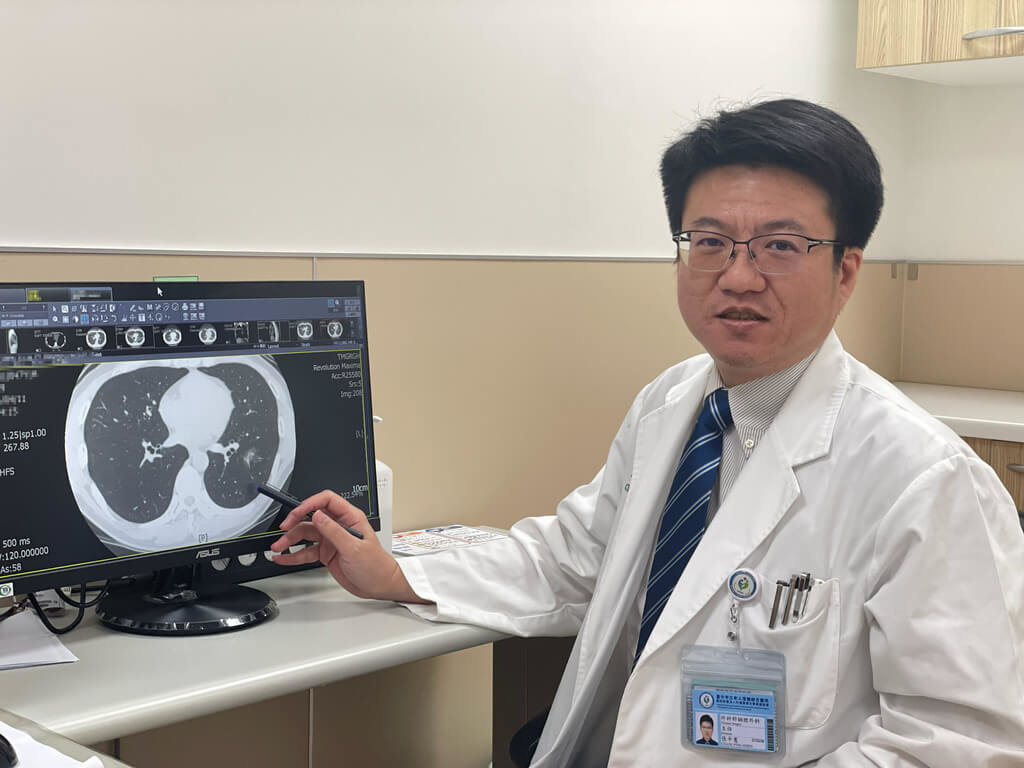
Story Text
Central News Agency Report
A 47-year-old man from Taichung City, with a 20-year smoking history, successfully quit smoking four years ago and has been undergoing regular health check-ups every two years. Last year, a liver tumor was detected during a check-up and promptly treated. This year, a follow-up lung CT scan revealed a ground-glass opacity nodule measuring approximately 2.4 cm in the left lower lobe, with partial solid components, prompting further evaluation at the thoracic department.
Dr. Ping-Hsien Chang, Director of the Department of Thoracic Surgery at Taichung City Elderly Rehabilitation General Hospital, explained that the nodule was located centrally in the left lower lobe and adjacent to critical blood vessels, making a local biopsy unsuitable. After confirming good lung function, the medical team recommended a lobectomy. Following thorough discussion, the patient opted for a robotic-assisted da Vinci surgical system procedure, combined with an Enhanced Recovery After Surgery (ERAS) protocol.
During surgery, frozen section pathology confirmed stage 1 lung adenocarcinoma, leading to immediate completion of lobectomy and lymph node dissection. Postoperative recovery was smooth: the chest drainage tube was removed the next day, and the patient was able to walk and be discharged on the second postoperative day. He has since returned to normal work activities.
The patient shared that despite having no symptoms, seeing friends diagnosed with lung adenocarcinoma reminded him not to neglect his health. He emphasized that early detection through regular screening, combined with precise medical intervention, allowed him to recover faster than expected without disrupting his daily life. He encourages the public to utilize health check-ups for early detection and treatment to protect themselves and their families.
Dr. Chang noted that according to the latest statistics from the Ministry of Health and Welfare, lung cancer has ranked first in both incidence and mortality among cancers in Taiwan for many consecutive years. In the past, most lung cancer cases were diagnosed at stage 3 or 4, leaving only about 20% eligible for curative surgery. However, with the growing promotion of low-dose computed tomography (LDCT) lung screening, more patients are now being diagnosed at earlier stages, significantly increasing the chances of cure.