ニュース本文
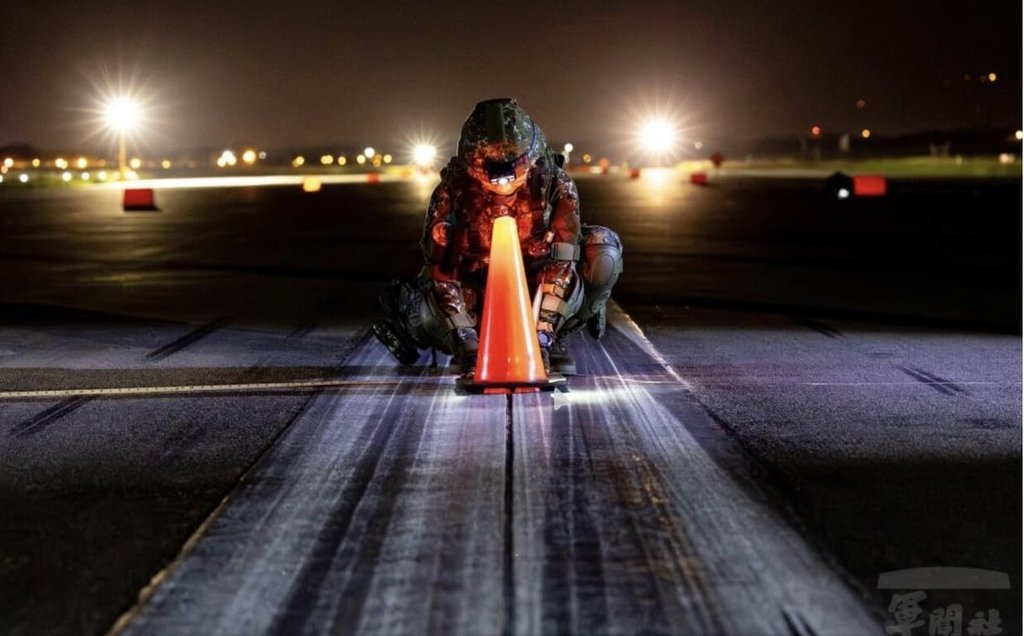
Central News(Central News Agency reporter Yu Kai-Xiang, Taipei, July 14) The Republic of China's Joint Defense Exercise entered its second day, and the Military News Agency reported today that the Air Force's Education and Training Division, Base Training Department, conducted a nighttime runway and taxiway repair drill yesterday. The drill simulated an airport runway damaged by enemy firepower, with personnel rapidly deploying under low visibility and time pressure to validate the unit's nighttime response, engineering repair, and command-and-control capabilities, ensuring the Air Force's sustained combat effectiveness.The five-day Joint Defense Exercise entered its second day today. Compared to the Immediate Readiness Exercise held in June—which focused on enemy pre-launch detection, initial military preparedness, and transition from peacetime to wartime—the Joint Defense Exercise simulates scenarios in which enemy forces are detected launching and entering territorial waters. It emphasizes the integration of all three military branches (Army, Navy, Air Force) and joint operations, focusing on decentralized execution of the kill chain, validating 'distributed command' and command-and-control (C2), and implementing the 'Rules of Engagement' (ROE).According to the Military News Agency, the Air Force's Education and Training Division, Base Training Department, conducted a nighttime runway and taxiway repair drill yesterday as part of the 'Joint Defense Exercise.' Simulating runway damage from enemy fire, personnel rapidly deployed under low visibility and time pressure to validate nighttime response, engineering repair, and command-and-control capabilities, ensuring the runway could be restored for use as quickly as possible and maintaining the Air Force's sustained combat capability.The Military News Agency reported that upon receiving orders, the repair unit immediately completed personnel, equipment, and machinery preparations, deploying combat engineering vehicles and lighting equipment to the damaged runway area. Personnel sequentially conducted damage assessment, lighting setup, crater filling, rapid repair mat deployment, approach lighting system restoration, arresting gear inspection and adjustment, and establishment of the minimum takeoff and landing zone. Following standard operating procedures, they completed runway repair and foreign object debris (FOD) prevention measures, re-establishing aircraft takeoff and landing conditions while ensuring safety, timeliness, and quality.The Air Force's Education and Training Division emphasized that this drill adopted a 'real personnel, real location, real-time, real equipment, real operation' approach, integrating actual environments and scenario-based inducements to validate personnel organization, equipment operation, and coordinated operational efficiency. Through realistic nighttime repair drills, the exercise strengthened personnel's battlefield damage repair expertise and adaptive capabilities, enhancing the base's all-weather readiness and the operational resilience of joint defense operations. (Editor: Wan Shu-Zhang) 1150714Stand with the facts—your support is the power that protects press freedom.Download the Central News Agency 'First News' app to instantly access the latest updates.Text, images, and videos on this website may not be reproduced, publicly broadcast, transmitted, or utilized without authorization.